How Gratitude Improves Mental and Physical Health

Written by: Toni Privado, Graduate Student Intern
In America, we often think about gratitude more as the holidays approach, but research reveals that gratitude improves all aspects of our health: physically, socially, and psychologically. I have read numerous articles that provide the benefits of being grateful. Personally, I was intrigued to try to add gratitude into the daily routines. The overall impact on my life was remarkable.
5 Mental Health Benefits of Gratitude
1. Creates More Happiness and Optimism
2. Positively Changes Your Brain
Research shows that by practicing gratitude, we can change our brains to automatically default to an attitude of gratitude. Hebb’s law is a theory that states, “Neurons that fire together wire together.” Each time we think a thought, we are creating neural pathways in our brains. Each time we think of a negative thought, we are building connections in our brains to think negatively in the future. The same happens with positive thoughts.
Ultimately this means whatever we pay attention to grows stronger as the neural pathway connections in our brains grow stronger. Practicing gratitude, our attention shifts and creates pathways for a lifestyle of gratitude and all its benefits.
3. Eases Symptoms of Depression
When we experience gratefulness, our bodies release dopamine, serotonin, and oxytocin, which are all “feel good” hormones. These “feel good” hormones allow a person to experience an overall sense of well-being.
4. Reduces stress
When we think about what we are thankful for, our parasympathetic nervous system kicks in. This decreases the stress hormone, cortisol, and may increase the bonding hormone, oxytocin.
5. Increases Emotional Resilience
Research reveals that gratitude helps people recover from trauma and become more resilient.
As you can see, a lifestyle of thankfulness is powerful. I can attest that in the 30 days that I expressed gratitude, I noticed a difference in how I felt physically and mentally. Now imagine if you were to add gratitude to your lifestyle. You would be able to experience the various benefits of being grateful. Small, healthy habits can have a positive impact on your mental health.
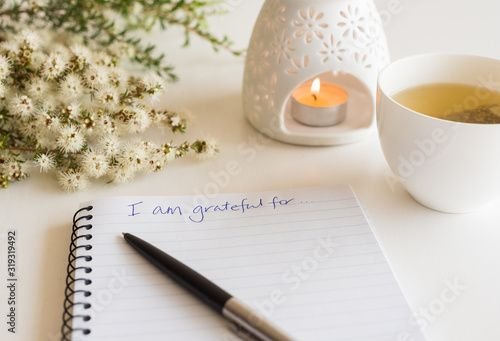
Ways to incorporate gratitude into your life
Keep a written gratitude journal
Write thank-you notes
Send a gratitude text to a friend or loved one
Notice the little things you are thankful for
Replace “sorry” with “thank you” (i.e. “thank you for waiting for me” instead of “sorry I am late”)
Tell your loved ones why you appreciate and love them
For 30 days, I wrote in my gratitude journal. In the mornings, I would write down 10-15 things that I was grateful for in my life currently. Once I started to write, the pen began to flow on the page with ease. I felt warm inside, thinking about everything that I was grateful for in my life. I noticed a remarkable difference in my mood when I was expressing my gratitude. I also took time to write a gratitude list at the end of the day before bed.

Here are a few of the daily gratitude prompts that I utilized:
Today, I am grateful for...
Three things that went well today are...
I am happy to be alive today because…
My favorite thing about today was…
Today, I am most looking forward to…
One person in my life that I am thankful for is…
Something I learned today was…
Would you like to explore ways healthy habits can improve your overall wellbeing?
Schedule a Session at Restoring Hope Counseling Today.

Restoring Hope Counseling has multiple Therapists on staff with some who are able to take insurance, and some who are interns and provisionally licensed staff, who can provide counseling at a discounted rate. They all provide in Person or Telehealth sessions. Visit our “Meet our Team” page or contact us for further information to help you find the person who is the best fit for you.
Anxiety isn't always what we picture. For many people, it's quiet, constant, and easy to miss — until it isn't. Learn what to look for in yourself and the people you love.
Triggers aren't just "something upsetting." They're present-day events that activate old wounds, survival responses, and nervous system patterns. Houston therapist Cami Tisnabudi breaks down what's really happening — and how to work with it.
Children communicate through play — it's their native language. A Houston play therapist explains what actually happens in a play therapy session and why it works.
Your 20s are supposed to be the best years of your life — so why does constant anxiety feel like the defining experience? Houston therapists explain the psychology behind it.
ADHD is one of the most misunderstood diagnoses in mental health. Learn what's really happening in the brain — and how it shows up differently across ages and genders.
You know your triggers, your history, your patterns — but your body still carries the weight. Somatic therapy can bridge the gap between understanding and healing.
As a former coach turned psychotherapist, Celeste Osborne shares what years of watching athletes compete taught her about the overlooked mental side of performance.
Children need space to explore — but they also need limits. A Houston play therapist explains how to set boundaries that teach, not just restrict.
If racing thoughts, constant worry, and inability to rest are overshadowing new motherhood, it may be postpartum anxiety — not just nerves.
From lesbian to asexual to identities you may have never heard of — this accessible guide helps allies, parents, and curious readers understand the LGBTQIA+ spectrum.
Attraction is more complex than most of us were taught. This introduction to our LGBTQIA+ series unpacks the different types of attraction and why they matter.
When every conversation ends in hurt feelings or shutdown, something needs to change. These communication tools can help couples break the cycle and start actually hearing each other.
Boundaries are one of the most discussed concepts in mental health — and one of the most misunderstood. Here's what they actually are and how to build them.
Self-care has been co-opted by wellness culture — but real self-care is quieter, more intentional, and far more meaningful than a spa day.
A hand on the shoulder. A knee squeeze in the car. These micro-moments of touch do more for your relationship than you might realize.
Physical training gets all the attention — but the mental side of performance is where championships are actually won and lost.
We are wired for connection — literally. Limbic resonance is the science of how one nervous system attunes to another, and it's at the heart of why therapy works.
"I shouldn't have to ask." "I'm not a mind reader." Sound familiar? The mental load in relationships is real — and it's wreaking havoc on couples who don't know how to name it.
Cultural stigma, language barriers, and lack of representation make accessing mental health care harder for Houston's Latinx community. Here's what's available — and how to access it.
The skills therapists use in session — active listening, validation, repair — can transform your everyday relationships. Here's how to put them to work.
Your story isn't just what happened to you — it's how you make meaning of it. Narrative therapy helps people reclaim authorship over their own healing.
Your teen is navigating more than you may realize. These five approaches can help you stay connected, supportive, and effective during one of life's most turbulent chapters.
You don't need a perfect journal or a writing practice to start — you just need a pen and a few minutes. Here's how journaling can genuinely support your mental health.
"I am worthy" can feel like a lie on hard days. But self-worth isn't something you achieve — it's something you return to. Here's how.
How can you set goals to help you Thrive in 2025? This has been quite a year. A year that followed an incredibly taxing and stressful year. But we have made it. We have made it to another year, and are ready to conquer the next one. But not just survive it, THRIVE in it.
As I think about what it means to Thrive in 2025, I have spent time thinking about goals that I have, things that I want to accomplish, for myself and for Restoring Hope.
It’s that time of year again, the air is cooler, with sweater weather becoming more of a norm. Everyone is wearing their beanies and jackets; it all seems to fit perfectly with Christmas right around the corner. It’s a great time of seeing family, spending time with friends, eating sweets, and looking at Christmas Lights. But not everyone feels the same way about the Holidays.
For some people, this time of year can be the worst or most stressful time of the whole year.
It is that time of the year again where the expectation is to be full of cheer, joy, and happiness but the reality is stressful, overwhelming, and exhausting. With holidays approaching there is all sorts of pressure and expectations (whether placed on you by yourself or those around you) and it can be difficult to manage.
The first thing I want to emphasize to you is that YOU ARE NOT ALONE! There are so many people who are not feeling the holiday spirit but feel guilt or shame in expressing that.
Grief is a deeply personal experience, and while there is no "right" way to grieve, many people seek out support in navigating the overwhelming emotions that come with loss. One such approach is Acceptance and Commitment Therapy (ACT) a powerful psychological framework that can help individuals face the pain of grief while maintaining a sense of hope and meaning.
In this post, we’ll explore what ACT is, how it can support those who are grieving, and offer five practical tips for applying ACT principles to your own grief journey.
The first step in becoming a better ally to the transgender and nonbinary is to learn more. There are many things you may not know, and you will probably make some mistakes along the way. It is crucial to understand that it is okay to make mistakes along the way as long as we learn from them. To be an ally is to put in some of the work on your own. It is not the responsibility of the LGBTQ+ community to educate you. You must take accountability and put in work/research.
As a therapist, I work with all types of people, teens, men, women, and couples, I have discovered there is one main thing we all have in common.
Every single person who exists or has existed at one point or another has one desire that at is at the core of who they are. It doesn’t matter how they grew up, what they experienced, how privileged they were, what race they are, or what gender. There is one thing that everyone desires.